Tuesday, November 6, 2012

Pandora's Box


            Data mining sounded creepy in the text, but it isn’t that bad until you realize that you’re a part of it, too. Leading up to election season, political ads targeting young people were blitzing the Internet, and I managed to find myself the specific target of an ad. Listening to my favorite bands on Pandora, I was shocked to suddenly hear President Obama informing me that millions of Ohioans have voted early. I wasn’t that creeped out, but going over it after reading about data mining made me ask a couple questions: How did they know that I’m from Ohio? How do they know that I’m part of a demographic that would want to vote early? It’s a bit discomforting to know that someone managed to get that information out of me.
            But can we really blame advertisers for using this tool? If they can figure out my age group and my home state, I’m sure that other advertisers have other information about me. Who knows what I’m being sold, and what I’m going to be sold, without my knowledge that it’s being targeted specifically at me? And is that even such a bad thing? In an odd way, I enjoyed the thought that the Pandora ad was made specifically for me and others like me. The ad will probably encourage many people on both sides to vote that normally would not. Ohio is going to be an intense battleground state this year, so why not use all of the tools available? Sure it’s creepy, but it works, and many people don’t even notice that it’s happening. Many websites are data mining in much more voluntary and much less creepy ways. Hulu plays ads while you watch, but it asks if you think that an ad is relevant to you while you watch. You can select yes or no, and it will determine what ads it shows in the future based on what you selected as relevant or irrelevant. It’s possible that these preferences are passed onto a shady information group, but what do you care if you’re enjoying your Hulu commercials? Looking forward, we have to weigh the pros and cons of losing our privacy.
            We shouldn’t be too afraid of losing our privacy because we are called to live in a way that exposes our lives and actions to others. We are called by the Great Commission to make disciples of all nations, so what do we have to fear from others knowing more about us? We ought to live in such a way that others will look at our lives and recognize that what we have is evident and wonderful. Fighting for our privacy seems like a waste of time in contrast to our goal and our calling. We have to take care that we are in the world and not of the world as we live in a world of advertisements. Our witness is going to be put to the test if we’re being watched, in any way.

Monday, November 5, 2012

Who's watching?


This past Saturday, I joined the rest of the world’s elite and became the proud owner of the new iPhone 5. I have been on the thing nonstop for the past 48 hours and let me tell you it is great. Anything I want to know is at a moment’s notice. I don’t even need to pull out my big laptop any more if I want to find out some information. Everything is literally seconds away.

                We live in a society today that is based on the advancements in technology and the latest and greatest products that come out for us to use. As I said before, we have access to any information we desire. It is just a touch away. If we are interested in any personal information about someone we are able to access it. Companies use this advertising technique (known as data-mining) to cater to what it might look like the consumer’s interests are. When you enter information for something such as an email address, a phone contract, etc. you are putting your information out there with the risk of somebody finding it out. Through this, companies are able to get some useful information as to what you, the consumer, might like to hear or see. This form of advertising normally shows up in our mail through letters, flyers, etc. Companies that send out those mass flyers that it seems like everybody gets are using data mining by extracting your address from a database somewhere. It is almost to the point where the government is able to watch our every move. We discussed in class on Thursday about this privacy issue. Maybe this concept of “data mining” has gone too far. Is there a line being crossed? Should there be boundaries as to what and how much information is out there available to anyone?

                An interesting point was brought up in our discussion and that is we shouldn’t be so upset about our privacy being invaded because we shouldn’t have anything to hide. If we aren’t doing anything wrong, then we should have no problem with people seeing our stuff. When meditating on this side of the argument, there are several verses in the book of Proverbs about integrity that stand out to me. Solomon says in Proverbs 20:7 that he who walks in integrity blessed. He continually talks about the integrity remaining steadfast and being able to hold themselves up while crooked people falter (10:9, 11:3, 28:18). 

I do believe that we should all live lives of integrity and be honest and sincere in everything we do because as Christians it is our job to lead by example and take up our cross each day. Looking at it from that perspective, we shouldn’t have a problem with people getting into our personal information because if we lived with integrity we wouldn’t have anything to hide. Unfortunately, this is not how the majority of the world sees it. With most of today’s society being secular, it is going to be very hard to convince someone to live with the same integrity that Jesus lived with. This is a big factor as to why data mining might be frowned upon for its invasion of privacy. While it’s nice to think that maybe everybody can live with the same accountability that we hold ourselves to, the reality is most people don’t think that way. The next time I’m going to look something up on my iPhone I’m going to extra cautious with the data I enter. Who knows who is watching.

Look like a baby!


I think it is safe to say that the above Walmart commercial is one of my absolute favorite commercials that I've ever seen. It’s adorable! These little girls actually think that this anti-aging face cream will help their grandpa look younger.

Though we chuckle at the naivety of the two girls, we must take a step back and ask ourselves if those children remind us of anyone – ourselves, perhaps? Do we buy into the hope that certain cosmetics products will give us a younger look or a better version of ourselves? We certainly do, seeing as the cosmetics industry is booming nowadays. There is no denying that people are concerned about how they portray themselves to society.

Let’s take, for example, a specific product that is particularly popular amongst women: hope in a jar.


This is literally called hope in a jar. It comes from a brand called Philosophy, sold nationwide in big makeup stores such as Sephora and Ulta. The brand carries a number of interesting products, or rather products with interesting names, such as “purity made simple”, “full of promise”, and “miracle worker”. Although there are numerous products we can discuss, we’ll narrow our focus onto hope in a jar.

Hope in a jar is sold for as little as $15.00 at 0.5oz and as much as $110.00 for 8oz. I guess hope in a jar can be pretty costly these days. On the philosophy website, hope in a jar claims to have antioxidant protection, as well as to improve skin texture and tone. To me, it sounds like the claims of many other moisturizers in the market. But to others, the product is their holy grail. Hope in a jar has achieved a good-standing status of popularity in the cosmetic world, and with its high price, it makes me wonder why people are so faithful to this product that claims very similar promises that other brands would make. It is really that much different from other moisturizers? Is it really “hope in a jar”?


What’s more interesting to me is the “philosophy” that is written for the product (each product of philosophy has their own written philosophy statement written on the front): “where there is hope there can be faith. where there is faith miracles can occur.” It sounds just like a nice, carefully-chosen set of words to me, but to others, it rings truth – enough to make their purchase. In buying “hope in a jar,” customers are placing high hopes in a jar. Perhaps this marketing trick for philosophy works for many others, but it has yet to work on myself. To customers, they are buying more than a moisturizer or more than the highly respected brand itself – they are buying miracles.

I thank God we don’t have to be like philosophy customers and put our hope in something so temporary. Who puts hope in a jar? Christians shouldn’t! Romans 5:1-2 says, “Therefore, since we have been justified through faith, we have peace with God through our Lord Jesus Christ, through whom we have gained access by faith into this grace in which we now stand. And we boast in the hope of the glory of God.” We have hope given to us from God Himself! Because we believe exactly what John 3:16 states, we can look forward to someday be with Him for all eternity in heaven. But in the meantime, because we have this hope, we don’t have to live putting our hope in other things because God has taken care of where that hope should be put. He knows that if we put our hope in Him, these earthly things won’t matter. What’s better than our hope of being with Him forever and ever?  No face cream will ever be better than that, that’s for sure!

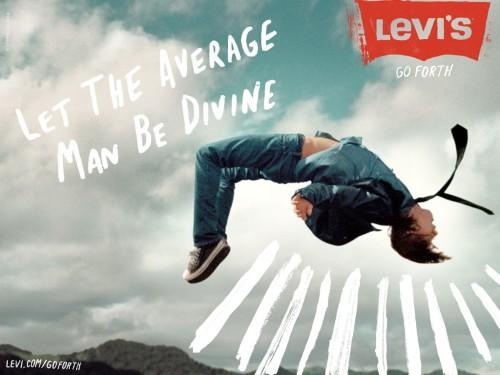
O Pioneers!--Hope in Denim Clad


     There's much to say about the commercial above, but, first and foremost, note the distinct paucity of jeans.  Levi's "Go Forth" campaign at times feels less like a commercial and more like a propaganda ad for a reality that doesn't exist.  This particular commercial and another one I'll show in a moment are both photographed by Ryan McGinley.  What's unique about his cinematographic subjects is that while the narrative they're punctuating is about ideals, they themselves are not idealized pictures.  To be sure, there is a gritty romanticism in the occasional orgastic explosions of sparks, and the subtle art deco influence on the poses stricken by many of the subjects, appearing to embrace the air.  For even in the grittiest of settings, the darkest and most desaturated of filters, hope shines through. 
     As such, the commercial's message of hope is empowered by the harshness and realism of imagery.  Hope can be spoken of in the abstract, but in context it often has the most power.  I say, "This commercial is about hope," and maybe you smile.  I say, "This commercial is about overcoming insurmountable odds," and now maybe you're already finding a way to relate.  Idealism alone can be perceived at times as naivete, but idealism grounded in a realistic understanding of the flawed nature of existence has the power to move the world.
     Again, there's very little talk of jeans in this commercial or anything surrounding the commercial. This is no accident.  Levi is selling jeans, but even moreso they're selling an aesthetic, an identification point.  People who buy Levi's are youth on the brink of change, youth who hear the transcendental words of Walt Whitman and take them to heart.  This is the romantic ideal behind the gritty imagery.  


Another commercial from the campaign:


        More Whitman, and more narration, though the recording quality of the narrative this time is much higher.  The youth in this campaign are depicted as roaring, running, bounding.  Levi is marketing to the "outcasts" of society, the young people who will one day change the world.  They are essentially trying to reclaim the edgy youth demographic, having once appealed to the Civil Rights Marchers and demonstrators of the sixties.  It should be noted that a brief depiction of homoeroticism is shown in this commercial, again looking for the voices at the edge of culture that stand poised to soon be the voice of culture.  In the previous commercial, the romantic display of passion was a heterosexual, mixed-race couple, and the fact that this is meant to be edgy says a lot about how far our perceptions of cultural norms have to come.
     The hope of the young revolutionary can and will fail us.  The reason there are always cultural revolutions is because no culture built by man will be perfect.  History moves in cycles.  Romans 5:5, however, encourages us that "hope does not disappoint us, because God has poured out his love into our hearts by the Holy Spirit, whom he has given us."  Perhaps the creators of the commercial even understood this cyclical leaning towards error in the way they mostly handle the material with realism and resignation.


The young people will try to change the world.
     We might as well sell them our jeans.

Being Known


And I thought this was bad. 


I am always mind-blown by the amount of information people are able to obtain about someone. The bank-robber in Firewall had been studying Harrison Ford for months and knew and exploited nearly everything about him and his family, including his son’s peanut allergy. Or take the Bourne Trilogy for example; I am continuously taken aback at just how much information and data the CIA has access to and how incredibly difficult it is for Jason Bourne to make the slightest move without being detected. To me, this is fairly believable because it is the CIA after all, but in the end it is still just a movie-right? The thought is terrifying that marketers have just as much and often more access than the CIA or the stalkers we see so often in the movies.

It did not register with me just how much I am personally victimized by this until reading Brandwashed. Now that I think about it, I did get an email last week from Southwest airlines about cheap flights to St. Louis. This strikes me as odd seeing as I have never looked up flights to St. Louis on their website. I have, however, used other websites such as Amtrak and Megabus to figure out how much a trip from Chicago to St. Louis would drain from my bank account. I’m beginning to think this Internet activity of mine is not unrelated to Southwest’s specialized offer. I got an email just today from Panera asking me to take a survey. “We’re looking to spotlight you! Tell us your story.”  How nice of them to give me the “opportunity to share me,” all the while gathering more information in order to manipulate me more effectively. What about all those Chipotle commercials on Pandora? I thought that was just the ad that interrupted everyone’s music on Pandora. Nope. I just asked several of my friends, and I seem to be the only one that experiences those commercials excessively. Could that have something to do with the fact that Chipotle is one of my favorite restaurants, and I purchase food there more frequently than other places? I would not doubt it.

I’ve been successfully convinced that companies know a lot about a lot of people, and frighteningly, about me. What does all this data say about us? Can we, as people, be reduced to mere data and numbers? Brandwashed states the brands we buy are “the windows into our soul.” That brings up an interesting idea. We as humans have souls, and as Christians we would generally say our souls are what truly constitutes us. So can we truly be defined by data? I do not know if I would go far as to say that marketing companies can know our souls, since only God can truly know that, but they sure have access to a deluge of information that can reflect our souls. If that’s the case, maybe we as Christians should think about what kind of soul our buying habits and interaction with phones and the Internet reflect.

Almost anyone would admit that the thought of companies knowing so much about us is frightening. Perhaps that is because this type of knowledge, if put in the wrong hands, could have horrific consequences. If people are anything like me, though, my biggest fear is not that my well being will be compromised or that I will be discriminated against. Rather it simply makes me uncomfortable that strangers can know so much about me. Lindstrom discusses men who buy pornography. Many of us do not have anything quite so drastic to fear being known. Nevertheless, we probably have something in our texts, Facebook messages, or Google searches we would not want to be publicized. How about that venting session you just had with your best friend about your mom or your roommate? We’ve probably all had our stomach drop the moment we think we sent a text to the wrong person. I was hit by the realization, though, that we as Christians are called to live blameless lives. Speaking of venting, Philippians 2:14-15 says “Do everything without grumbling or arguing, so that you may become blameless and pure, ‘children of God without fault in a warped and crooked generation.” We are not called to simply appear blameless in only the things people can find out about, but to be thoroughly pure and holy, even in our thoughts and the “hidden” content of the cyber world. The thought of marketers knowing our “dirty little secrets” makes us uncomfortable, yet we forget that God knows all of that anyway, which is far more consequential and should challenge us.  While this can definitely be disconcerting thought, we can also find comfort in the fact that we serve a God who knows infinitely more about us than marketers could obtain from any compilation of data.

Cynicism in a Jar


I was a little disappointed – and yet, also filled with an odd sense of accomplishment with my predictions – when Lindstrom turned his focus in chapter 8 from superfruits to facial cream…because the first thing that came to my mind when he was describing the (essentially) false advertising of acai berries, goji berries, etc., was Proactiv. Even though he didn’t come out and use the example of Proactiv, I think the underlying principles are the same with anti-aging facial creams – the same hopes carried by superfruits and every other product we’re gotcha’d by through this marketing scheme.

I am a full-blown advocate against Proactiv. If they are even still around, I would like to offer you an invitation not to try it. Don’t waste your time. I’ve never had an extreme war with acne, but it has been something that has followed me for years. When it was at its worst, my dad insisted (based on a television ad) that Proactiv was the way to go.

And I mean, talk about “Hope in a Jar.” Let’s go through the countless face-models Proactiv has had: Jessica Simpson, Julianne Hough, Avril Lavigne, Kelly Clarkson, and everyone’s favorite, Justin Bieber. (Forgive me if I’ve forgotten a few hundred.) All of them seemingly having overcome their terrible acne, thanks to Proactiv.

Lindstrom talks a lot about word and image association with products as a vessel of our hope. With the popularity of Proactiv (especially at that time), all I can say is that I didn’t live under a rock. I knew about Proactiv. I knew about – and yes, even felt – the hope that came with it. It was a hope that I, someday, might have as good of skin as a celebrity.

Not only was this celebrity status associated with Proactiv in my mind, but there was the ever-so-popular “before and after” shots (that need to accompany any good image-enhancing product advertisement). Those are what stuck in my mind the most, the number one association for me. Even if I didn’t make it to celebrity status by using Proactiv, at least I’d have my “before and after” shots on television ads. Maybe I could even do a short testimonial for them. I was in the before, and I was (hopefully) longing for that after.

It obviously didn’t work for me. And while I guess I’m not trying to make the claim that Proactiv definitely will not work for you, I do want to say that the idea that it definitely will work for you is bogus, and is, for what it’s worth, one of my biggest grievances with advertisements in general. Just as with the claim that drinking superfruits will make you healthy, there is hardly ever research presented to back claims up. Marketers get an association in your mind – whether that be rain forests or smooth, celebrity-esque skin – and they run with it.

I feel like we are so desperate as a consumer-driven society to grab on to the next big thing. It doesn’t even matter what it’s for. As long as it gives us hope in a better future (usually manifested in the form of a better self, I’m sad to say), we want to try it. It’s got to work. Our “hope” is nothing more than crafty (and deceitful) persuasion.

My Proactiv experience is one of many experiences where I’ve had false hope in something, only to have my hopes fade to cynicism. As I hinted, I have many complaints about, well, probably everything society has ever placed on a pedestal. For me, it just goes to show that we can trust in our worthless idols, or simply put our trust in God to provide us (simply) with all that we need.

Think Pink


Hope is such a prominent idea in our society. I think it is because it is a term that can be used in so many different contexts. From hoping that you aced that Bio exam that you pulled an all-nighter studying for, or hoping that one day you’ll have a family that you support with a stable job, hope is everywhere! So let’s take a moment to define hope. Dictionary.com defines hope, in the noun form, as “the feeling that what is wanted can be had or that events will turn out for the best”. So, in this way, it makes sense that hope can be used in many different contexts.

One huge example in society today where hope is used is disease and illness; or rather the curing of said ailment. And one of the most prominent diseases around, or at least advertised in the media, is cancer. Predominantly breast cancer, the media markets to our hopes that one day this horrible disease will be wiped out by selling us cute pink things that will supposedly “cure” cancer. From pink office supplies to gaudy pink rain boots sold by the NFL, everyone is getting in on the action to support breast cancer research. But what sort of impact is this really having on the funds to fight against cancer?
 
I recently read an article titled “The Silliest Pink Crap Money Can Buy, None of Which Will Cure Breast Cancer” (you can read it here for yourself). The article reminds its readers that, although these products that are marketed as donating to breast cancer research do in fact give money, it is a very insignificant amount. So although you may feel like you have good intentions by buying these products to help a good cause, it would in fact be more beneficial had you simply donated money directly. These marketers know that they are making themselves look good by donating proceeds, and by doing so they are raking in the profits.
 
But is this really all that bad? Although only small portions of the profits are donated to breast cancer research (usually somewhere around 10-20% at the most), they are still getting the word out. Even if you are not purchasing these products, seeing them on the shelves and on the web gets the idea of donating money into your head. So to say that these tactics themselves are totally bad would be a shame; we as consumers just need to realize which is actually the more philanthropic route and which is mainly routed in consumerism.

I think it’s interesting that Jesus adopted the exact opposite idea. There are many instances in the gospels where, once Jesus has cured someone of some sort of ailment, he immediately turns to his disciples and tells them to keep this hush hush. Jesus didn’t need any support for his cures, except for that of his heavenly Father. I’m not sure how advertisers can apply this particular idea to their marketing strategies; I just think that it is interesting how Jesus goes about “marketing” himself. Obviously it is working very well for him, because we are wonderfully “surrounded by such a great cloud of witnesses” (Hebrews 12:1), we are able to fully pursue Christ right where we are, without buying a thing.